Table of Contents
Who is Jawaharlal Nehru?
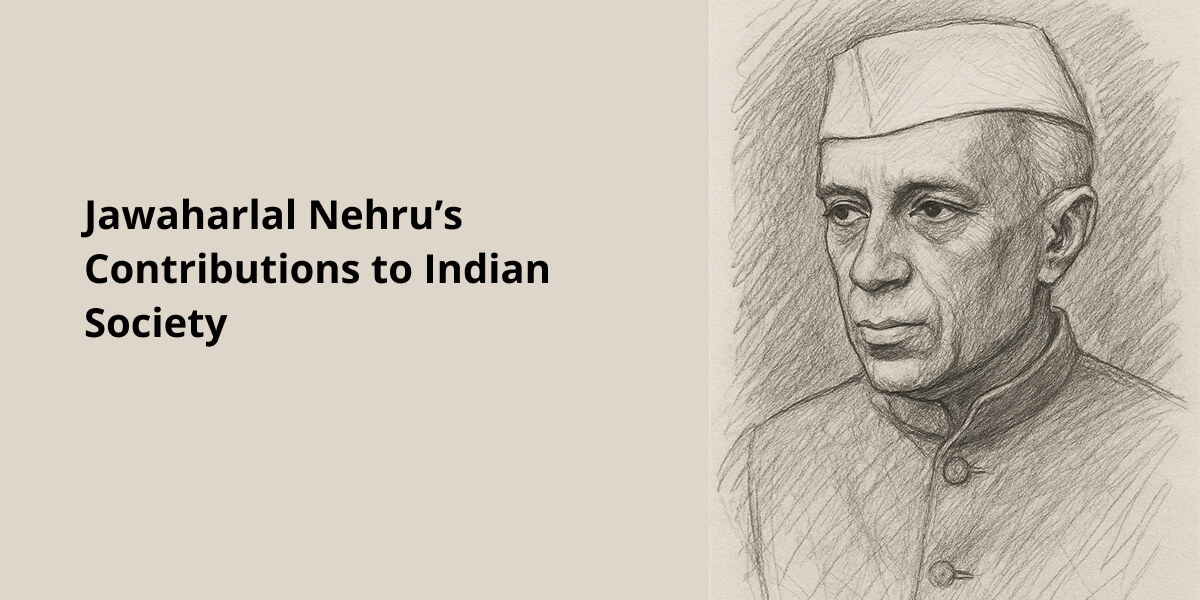
When someone mentions children, a coat with a rose and Gandhi cap- instantly one name comes to the mind- Jawaharlal Nehru. Known not just as the first Prime Minister of independent India, he is also known for his affection towards children and his distinctive style of dressing. He was born in a family with remarkable aptitude and scholarship. Having studied at some of the renowned institutions, Nehru had an excellent academic background.
He was a key- figure in the freedom struggle and actively participated in various freedom movements such as ‘Quit India Movement’, ‘Non- Co-operation Movement’ and ‘Civil Disobedient Movement’. Moreover, he played a key role in shaping the democratic framework of India.
Related Blog: Indira Gandhi’s Legacy: Her Key Contributions to Indian Society
Jawaharlal Nehru’s Key Contributions to Indian Society
Nehru played a pivotal role in shaping independent India. He is known as the ‘Architect of Modern India’ due to his vision for a strong independent India.
1. Advocated for secularism and democracy
He envisioned an India that does not favour one particular rather the nation provides equal opportunities to all the citizens irrespective of their religion. His approach involved building a positive, tolerant and harmonious society.
2. Worked on the progress of science and education
He was of the opinion that fostering a scientific and educated environment is crucial for the development of the country and for this he established IIT, IIM, AIMS- the leading educational institutions in India. He conceived the idea of these institutes producing some of the top engineers, scientists, and technology enthusiasts.
3. Child Welfare Policies
He worked on providing education, healthcare etc. In addition, he advocated for the abolition of child labour. He believed that children deserve a dignified environment. His birthday is celebrated as children’s day which is a testament of his respect and commitment for children’s welfare.
4. Economic development
He played a significant role in shaping independent India’s economy. He was of the view that India should adopt a mixed economic model. He introduced the 5-year plan. This focused on agriculture, transport and communication, power and service. The idea behind this initiative was to promote growth and self- efficiency.
5. Non- alignment policy
During the Cold- war era, India chose to not join the major power bloc. This was to ensure that India stays away from conflicts and to focus on the development of the new independent India. Moreover, this emphasized on peaceful resolution of international conflicts.
FAQs About Jawaharlal Nehru’s Contributions to Indian Society
Below are some of the frequently asked questions
Q1. What was Nehru’s role in the Non-Aligned Movement?
Nehru along with leaders from other 4 nations- Tito of Yugoslavia, Nasser of Egypt, Sukarno of Indonesia, and Nkrumah of Ghana initiated the Non-Alignment Movement. Nehru saw this movement as a medium to promote international peace. His concept was solidified in the Baldung conference which paved a path for the formal establishment of NAM.
Q2. What are the key social contributions of Jawaharlal Nehru to India?
He championed a secular nation, upheld the idea of democratic values- establishing India as a sovereign state. He advocated for child welfare programs and worked for the educational progress of the youth by founding some of the key institutions of the nation- thus building an egalitarian society.
Q3. How did Nehru shape India’s economy and education system?
Nehru opted for a mixed economy which focused on social justice and equitable development. He established institutions such as IIT, AIIMS, IIM STRENGTHENING India’s educational landscape that further sowed the seeds of academic excellence.
Q4. Why is Jawaharlal Nehru called the architect of modern India?
He is called the ‘Architect of Modern India’ since he played a pivotal role in steering India’s political and socio-economic framework. Like an architect he laid the foundation for a modern and developed India.
Q5. What is Nehru’s legacy in today’s India?
He played a crucial role in the established of parliamentary system, scientific research bodies
He along with Zhou Enlai introduced Panchsheel i.e Principles of Peaceful Coexistence- a set of principles for international relations. Moreover, he championed a secular and egalitarian society.
Conclusion
Although his policies faced challenges and underwent changes- he is known to be the longest serving PM of India who thought about the development of India from a holistic lens. His legacy is extensive and India continues to follow his values which still stands relevant in today’s time.