Table of Contents
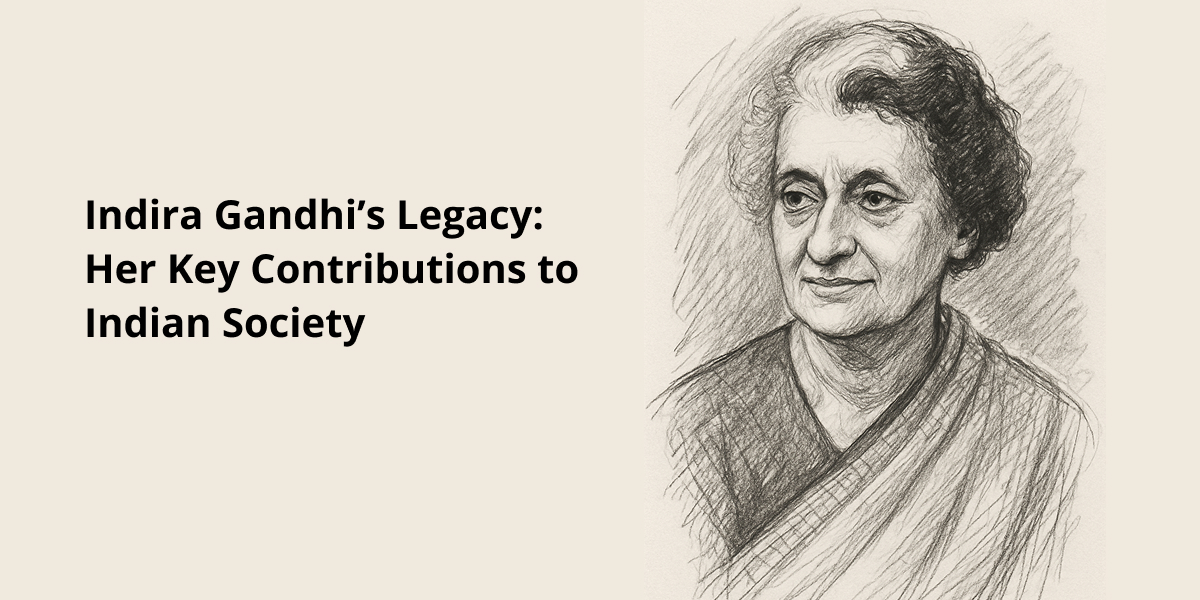
The power to question is the basis of all human progress – said Indira Gandhi the first female Prime Minister of India. She broke societal norms while navigating through challenges and transformative movements.
She is remembered for her bold leadership including the dissolution of Lok Sabha. Her leadership was defined with a vision of national development, and her era in Indian politics sparked both- development and controversies.
Who is Indira Gandhi?
Indira Gandhi was born on 19th November, 1917 to a family that had a deep- rooted connection to Indian politics. She was the daughter of the first Prime Minister of India, Jawaharlal Nehru. Her journey in politics was influenced by her family’s legacy in politics. She was a part of the political decisions from a very young age. The Quit India Movement not only shaped her political consciousness but also a strong will to fight for independence.
Driven by a resolute spirit, she is known to be a decisive leader. Her fearless decision making ability made impactful changes at both a domestic and global level. The same decisiveness earned both praise and criticism. Despite all of this she still stands to be an influential and strong political figure.
Related Blog: Jawaharlal Nehru’s Contributions to Indian Society
Indira Gandhi’s Key Contributions to Indian Society
By introducing landmark policies, Indira Gandhi changed the trajectory of the nation’s political and socio-economic conditions.
1. Nationalization of Banks
In July of 1969, Indira Gandhi nationalized 14 banks. This decision was taken keeping in mind the alignment of the banking sector with the socialistic goals of the government and to make banking accessible in the rural areas that aided social and industrial reforms.
2. “Garibi Hatao”- Poverty alleviation
This was the central theme of Indira Gandhi’s 1971 campaign. She initiated programs that focused on social welfare like minimum wage program that aimed to provide basic healthcare, education, and shelter to the poor.
3. Green Revolution
She actively participated in this movement by promoting HYV seeds. Moreover, she helped farmers by providing them with subsidies for water, fertilizers, etc. thus helping them to adapt to the new technology.
4. Emergency
This is widely considered to be India’s controversial era. This involved suspension of civil rights, press censorship, forced sterilization program and constitutional amendments.
Later she lifted the emergency and called for fresh elections in 1977.
5. Indo- Pakistan war
Indira Gandhi couldn’t fail to acknowledge the hostile conditions of the people in East Pakistan who were being oppressed by the Pakistan Army. Her decision to support Mukti Bahini (liberation group) and take a military lead led to the liberation of East Pakistan and the formation of Bangladesh.
India opened borders to over 10 million refugees and provided shelter, food and medical care. India became a key geopolitical nation in South Asia portraying India’s military and geopolitical strength.
FAQs About Indira Gandhi’s Contributions to Indian Society
As mentioned above, Indira Gandhi played an important role in India’s development.
Q1. Why was the Emergency declared in 1975?
The emergency was declared on June 25, 1975, as a response to internal disturbances and national security. This gave rise to political unrest where the press was censored and the fundamental rights of the citizens were suspended. It is said that this was the time India would have come closest to dictatorial rule and is often referred to as the darkest period of the nation’s history.
Q2. What was Indira Gandhi’s most significant contribution to India?
Indira Gandhi was a strong political figure who contributed significantly to India’s growth- one those arguably being her role in the Indo- Pak war of 1971. Additionally, “Garibi Hatao” movement and nationalization of banks fostered the nation’s upliftment.
Q3. How did Indira Gandhi shape women’s role in Indian politics?
Indira Gandhi being the first female prime minister of India, demonstrated the women’s influence and potential in the political sphere. Although her journey as the Prime Minister was far from easy and linear, she paved a path for future women of India to take up political power.
Q4. What was the impact of nationalising banks in India?
Nationalisation of Banks was a turning point in the financial sector of India. This was done with intention to promote economic development and expand banking access to the rural population. Nationalization has had both advantages and drawbacks. The drawbacks include political interference, decline in efficiency and they have been slower to adapt to technological advancements.
Q5. How is Indira Gandhi remembered today?
Indira Gandhi is remembered as a strong political figure. She is known for her initiatives towards foreign policy, supporting the Green Revolution, nationalization of banks etc. Her tenure was that of controversy and strong leadership.
Conclusion
The power to question is the basis of all human progress- Indira Gandhi. Her legacy was that of complexity and power. She advocated for a strong centralized state, agricultural reforms and addressed poverty. Despite all the controversies, she stands as an iconic figure known for her determination and enduring spirit.