Table of Contents
Mahatma Gandhi is one of the most historic figures in global history-an individual whose ideals of truth, non-violence, and simplicity not only transformed the movement of independence in India but also the world movements aimed at fighting and achieving justice. His life did not just involve making political campaigns but transforming the society at all levels of human dignity, equality and freedom.
Even now Gandhi is a beacon. In his philosophy, we learn that real power is not in violence or hierarchy but in tolerance, cohesion and moral fortitude. In order to get a grasp on his contributions, we must first look at Gandhi himself and the values by which he led his life.
Who was Mahatma Gandhi?
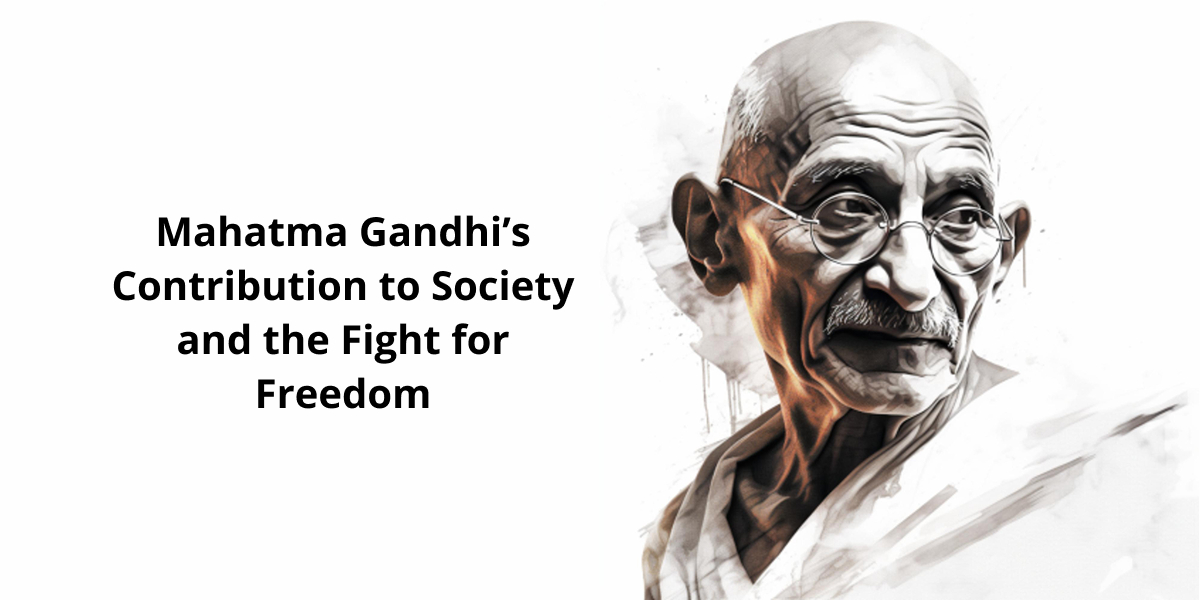
Mahatma Gandhi, whose full name was Mohandas Karamchand Gandhi, was a lawyer, political leader, and spiritual leader of India who became the icon of the Indian struggle against British rule in India. He was not a conventional leader who based his leadership on power or wealth, rather, he led through example where he lived a simplistic life of honesty, truth and service to people.
His name was not changed to Great Soul by any political authority but rather earned his place by those words and actions. Gandhi also subscribed to Satyagraha- the strength of truth and non-violent resistance and this was the foundation of his political activities. His strategy was ground-breaking at a period when immorality and brutality were the proven way of doing things.
More than a national leader, Gandhi was a philosopher whose sayings found a response outside a national frame. Other leaders such as Martin Luther King Jr., Nelson Mandela and many others were inspired by his approaches. The example of Gandhi speaks not only about independence of India, but also about the ability of the individual to transform the world by adhering to justice.
Early Life and Background
Mahatma Gandhi was born on the 2 nd of October 1869 in the coastal town named Porbandar which is presently situated as a part of the Gujarat state in India. Karamchand Gandhi who was a diwan (chief minister) of Porbandar and the mother who was very religious played her role in the formation of values of this little Gandhi. Due to her Gandhi recognised truth, discipline and compassion as the most valuable sources of power which became the main principles of his philosophic thinking.
Gandhi was meek and socially reticent as a child and could not easily be identified as a future leader. However, he lived with a high sense of morality dating to his early life days. At the age of 13, as child marriages were a common thing then, He married Kasturba Gandhi. At a later stage, their association would actually turn out to be a very strong partnership with Kasturba standing shoulder to shoulder with him on his quest to seek justice.
In 1888, Gandhi had gone to study law in Inner Temple in London. This was the point of turning his life. Although it was not an easy task to adapt to the Western civilization, living in London influenced Gandhi on some new ideas, philosophies, and the significance of being a citizen. After graduating, he went back to India and practiced law, however, it was only when he travelled to South Africa in 1893 that he found his calling, which is to battle against injustice and inequality.
Mahatma Gandhi’s Contribution to Society
Mahatma Gandhi was a freedom fighter who in addition to that was a reformer, who has redefined social change elements and what it takes to lead. His work was not only political, it reached into the moral, cultural and social purport of India. Gandhi demonstrated through his life and actions that through non-violence, unity and self-reliance, a whole nation could change.
1. The King of Non- Violence (Ahimsa)
When the world had thought that the power is based on weapons and war, Gandhi showed that the power resides in non-violence. He practiced and preached ahimsa (non-injury) and inspired Indians to strike British rule with passive resistance using non-violent methods hence protesting, boycott and civil disobedience. His rule of Satyagraha- clinging to truth- was a tool of moral action against wrong. This philosophy not only harmonized India, but also motivated civil rights movements all over the world
2. Struggle with the Social Inequality
Gandhi heavily criticized the caste system and went to the extent of elevating the Harijans (Children of God); the caste referred to as the untouchables to show them the respect of their position as the Children of God. He propagated social unity and struggled against discrimination and pointed out that there was no point in being independent without social equality. He shattered social boundaries and demonstrated the model of inclusivity by living humbly and freely mixing with people of all walks.
3. The Civil Disobedience and the Salt March
The Salt March of 1930 was one of the most memorable achievements of Gandhi. By walking 240 miles to the Arabian Sea and producing salt in rebellion of the British law, Gandhi transformed a banal action into the protest against slavery. The movement caused countrywide protests that inspired the world to realize the strength of mass, non-violent action. Even civil disobedience was made an instrument of revolt by common citizens against the British rule in Gandhi under his leadership, but without having to turn in to violence.
4. Raising of Self-Reliance (Swadeshi Movement)
Gandhi urged Indians not to consume British products but instead to purchase local products especially hand-spinning and weaving using the charkha (spinning wheel). This was neither a purely economic nor a self-respect issue. Wearing khadi (hand-spun cloth) Gandhi emulated the Indian capacity to be self-sufficient and not be subjected to economic dependency.
5. Focus on Advocacy of education and rural development.
To Gandhi, the major leap ahead would be the growth of villages since he believed that India lived in the villages. Passionate about the introduction of basic education based on applied skills, self-sufficiency and morals instead of rote learning, he was instrumental in introducing this kind of education. This was a rural development vision as suggested by him which became the precursor of what was then focused on strengthening the economy and society at the grass roots of India.
6. Propaganda to endorse religious harmony
India has several religions and cultures, and there was always an issue of communal issues. Gandhi was devoted towards achieving unity among Hindus, Muslims, Sikhs and Christians. He thought that religion was the same truth and was doing everything possible to avoid communal violence. His plea of peace among people during riots indicated his stand of religious unity.
Gandhi’s Assassination and Aftermath
Mahatma Gandhi was assassinated in New Delhi on January 30, 1948, just a few months after India had received its independence, by a Hindu nationalist Nathuram Godse who was opposed to Gandhi as he hoped to reconcile the religions and reach an agreement with Muslims. Gandhi was going to a prayer meeting when he was wounded by a shot. His final words, Ram, Hey Ram depicted his un-doubtning faith among even death.
The assassination did not affect only India but the whole world. Millions lamented the death of a leader that had turned into a peace and non-violence icon. India went into mourning and leaders the world over honored the man who had given a new direction in combating oppression to the world.
However, the death of Gandhi did not prevent his message. As a matter of fact, it magnified it. His quest of truth, simplicity and non-violence is more recognized even after his assassination. Gandhi started to be seen as a moral guide by the rest of the world rather than a leader of his motherland. His philosophy was furthered even after his death by such figures as Martin Luther King Jr. and Nelson Mandela, who demonstrated that the spirit of Gandhi remained to achieve change in the pursuit of justice and equality.
Lasting Impact on Modern Society
The life and philosophy of Mahatma Gandhi are being felt today even decades after his death. His values did not merely apply to the independence movement of India, as they have transcended to timeless guidelines concerning justice, leadership and humanity.
Among the most lasting contributions to the world made by Gandhi is the fact that evil is overcome by good and is also more effective than the use of violence. Gandhi philosophy was used by civil rights leader like Martin Luther King Junior in United States and Nelson Mandela in South Africa to fight their cause of racial injustices and apartheid. His teachings showed that nonviolent protesting can cause such a significant political and social change that does not involve bloodshed.
Gandhi also placed a particular attention on self-reliance and sustainability, which now makes sense in the context of the situation around the globe. His demand of simple life, domestic industries and respect of nature correlates with the current discussions on climate change, sustainable development and ethical purchasing choices. So many grassroot movements around the world are still inspired by his belief in fortification of villages and empowerment of the ordinary people.
Moreover, religious peace and societal non-discrimination envisaged by Gandhi remains a moral compass to societies that have not learned how to coexist. His argument that the enjoyment of freedom would not fulfill without justice to the marginalized groups of society makes his philosophy a guiding light to nations even nowadays.
In a nutshell, the influence of Gandhi did not happen too long ago and in one particular nation. His work changed the world in its thinking about power, leadership, and human dignity-and his relevance continues to grow as time moves on.
FAQs About George Washington’s Contributions to Society
The life of Mahatma Gandhi still evokes curiosity and people find themselves asking about those important events and thoughts that became defining moments in his life. These are the most common questions about his contributions:
Q1. What was Mahatma Gandhi’s biggest contribution to India’s independence?
Gandhi had the greatest contribution of incorporating non-violence resistance (Satyagraha) as the primary method of fighting the British rule. As opposed to armed action, he urged peaceful demonstrations, mass boycotts and Civil disobedience-techniques which brought many people in India together and undermined British rule.
Q2. What social reforms did Gandhi introduce in India?
Gandhi also endeavoured to eliminate some of the most long rooted social evils besides politics. He opposed untouchability, led women to equality, encouraged the rural development and elected to promote self reliance through the Swadeshi movement. His changes were designed to develop a kind of society that will be founded on justice and inclusivity.
Q3. How did Mahatma Gandhi promote non-violence?
Gandhi lived according to the principle of non-violence. He felt that schooled by the truth and love we can vanquish hate and repression. His methods of non-violence to fight the government and the foreign rules included peaceful protests and hunger strikes and also dialogues to show that non-violence was not the way of the mighty but it was the greatest strength.
Q4. How did the Salt March challenge British rule?
The Salt March of 1930 marked a significant change in the India freedom struggle. By going 240 miles to the sea and manufacturing salt, against the law, Gandhi boycotted directiy the British salt monopolist. This ritual speech motivated millions of people to participate in civil disobedience which shook the borders of colonial rule.
Q5. How is Mahatma Gandhi’s legacy remembered today?
The legacy of Gandhi exists in peace, justice, and equality movements all over the world. October 2 his birthday which is celebrated as International Day of Non-Violence. His message of truth and simplicity, and moral courage are still a guiding light to his impassioned followers who are leaders, activists, and ordinary citizens.
Conclusion
The life of Mahatma Gandhi was the service of truth, simplicity, and non-violence. He demonstrated that the world is not to treat freedom by aggression, but by patience, solidarity and ethical willpower. His work did not stop only at politics but covered social justice, equality, teaching and humanity as a whole.
Gandhi is so much more than a historical figure nowadays, as he is a guide, even in an age where we live. His values remain to guide leaders, movements and individuals, ordinary people towards a better, fair world of peace. The legacy of Gandhi reminds us that the change needs to be started with courage, compassion and the ability to do right things despite others views.