Table of Contents
The Tata dynasty has been India’s inspiration for more than a century. Jamshedji Tata founded the Tata Group in 1868 as a private trading firm and over the last century has become one of the biggest companies in the world. The Tata Group has had a great lineage of leaders; with every generation, they have inspired a myriad more.
Who is Ratan Tata?
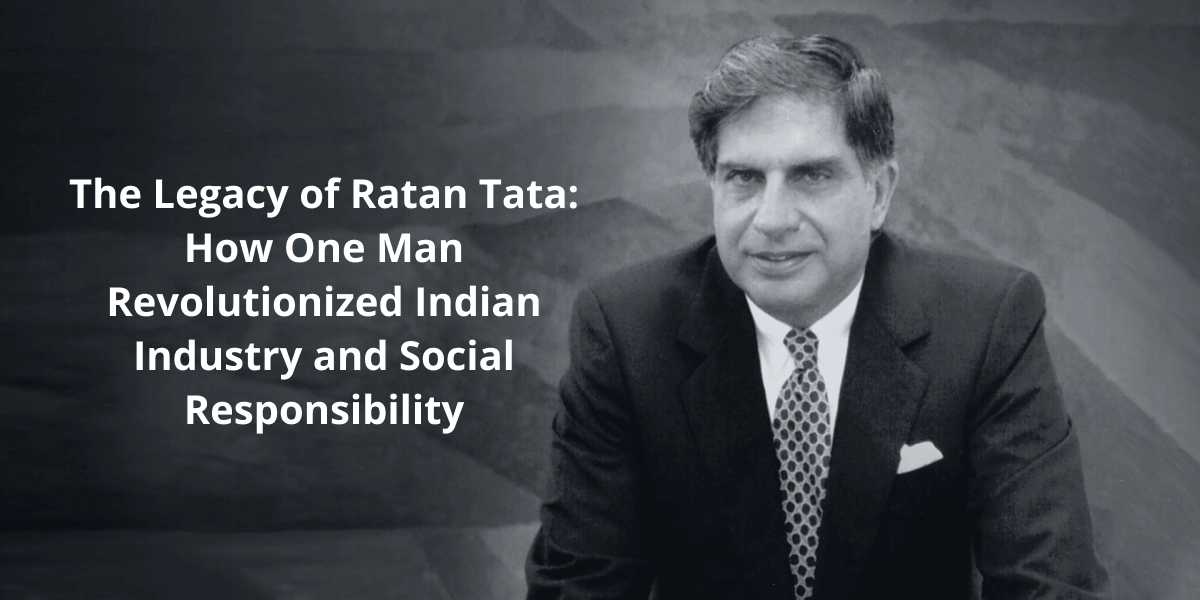
Ratan Naval Tata is one of India’s biggest industrialists and was the chairman of the Tata Group and Tata Sons. He is currently heading some charitable trusts in the name of the family. Ratan Tata is also one of India’s most inspiring individuals known for his philanthropy and leadership ideals.
Taking Leadership Role at Tata Group
The Tata Group has always been an advocate of Responsible Leadership and Corporate Social Responsibility and hence leaders of the company have been groomed to ascend the throne. Ratan was born in Mumbai and went to Cornell University to study architecture after his schooling. He joined the Tata Group in 1961 as a salesman on the company floor. He worked his way up to finally succeed JRD Tata in 1991 and become the chairman of the Tata Group and Tata Sons.
Ratan’s ascension to leadership was not taken well by some high-level executives and the media. He was accused of being incapable and inexperienced but after he made some structural changes to the company, he went on to achieve great heights and put the Tata Group on the world map as a global competitor across various industries. Under his leadership, Tata’s revenue went up by 40% and the company acquired some foreign companies to expand into other industries. Some of the famous acquisitions were Tetley Tea, Jaguar Land Rover, Corus Steel and Daewoo Motors.
Key Contributions to Indian Industry
Ratan Tata has been an inspirational model for young entrepreneurs and leaders of India. His business acumen coupled with his leadership skills and philanthropic perspective has improved Indian society and propelled our economy towards the objective of self-sufficiency.
- Ratan Tata introduced the Tata Nano which was an affordable car made for the common people. This increased population mobility and induced development within urban and rural spaces.
- Ratan Tata took Tata Group onto the international platform with the acquisition of companies like Tetley Tea, Jaguar Land Rover, Corus Group and a few more.
- The Tata Group advocated innovation and adaptability. With the acquisition of Jaguar Land Rover, Ratan Tata diversified Tata Motors and introduced them into the international market for luxury vehicles. These companies also aid India’s GDP.
- Tata invested heavily in technology and startup companies that were working in this domain and operating in digital market spaces like Paytm, SnapDeal, Lenskart, etc.
- Ratan Tata enhanced the role of Corporate Social Responsibility within the Tata Group and organized initiatives on education, healthcare, disaster management and rural development.
- Tata has a total of 29 listed companies on the stock exchange operating within multiple industries on a global scale. This illustrates the number of jobs that have been created by Tata Group.
- Ratan Tata has given seminars on business and leadership and contributed excerpts from various books thus educating and inspiring millions.
Key Social Responsibility and Philanthropy Initiatives By Ratan Tata
- The Tata’s have always been big on philanthropy and under the leadership of Ratan Tata, the Tata Trusts expanded their activities significantly introducing initiatives in education, healthcare, rural development and disaster management.
- Tata Medical Centre provides cancer treatment at a cheaper cost and serves the underprivileged.
- TISS – The Tata Institute for Social Sciences was established to produce professionals who will address social issues in Indian society.
- Tata Swach is a project to offer drinking water and water purification in rural and underserved communities.
- Tata Nano – A cheap car designed specifically for individuals with lower incomes.
- TPCDT – The Tata Power Community Development Trust was established to improve the quality of life and empower communities in India. It prioritized education, infrastructure, healthcare, and energy while promoting equitable growth policies.
Awards and Honours Received by Ratan Tata
Ratan Tata has been accoladed with many awards throughout his lifetime. Some of them have been mentioned below:
- Ratan Tata won the Padma Bhushan in 2008, which is one of India’s highest civilian awards for his contributions in trade and industry.
- The Forbes Lifetime Achievement Award in 2011.
- The Harvard Business School Alumni Achievement Award in 2013.
- The JRD Tata Memorial Award in 2015.
- Knight Commander of the Order of the British Empire (KBE) in 2009.
- The Lifetime Achievement Award from the Indian Institute of Management Bangalore (IIMB) in 2019.
Related Blog: Ratan Tata Contribution to Society: How One Man’s Vision Transformed India
FAQs About Ratan Tata
Q1. What is Ratan Tata’s educational background?
Ratan Tata studied architecture from Cornell University and then went on to complete an advanced management degree from Harvard University.
Q2. When did Ratan Tata become the chairman of Tata Sons?
Ratan Tata became the chairman of Tata Sons on 25th March, 1991.
Q3. What philanthropic activities is Ratan Tata involved in?
Some major philanthropic initiatives of Ratan Tata are Tata Nano initiative, Tata Institute of Social Science, Tata Swach, Tata Trusts, Tata Medical Centre, etc.
Q4. How has Ratan Tata influenced the Tata Group?
Ratan Tata changed the structure of Tata Group by updating the retirement age of high level executives. He increased the involvement of Tata Group in philanthropic initiatives. He brought Tata Group onto the International Market by acquiring international companies and diversifying operations within the firm.
Q5. What role does Ratan Tata play post-retirement?
Currently Ratan Tata heads certain trusts that run under the family name.
Conclusion
On a concluding note, Ratan Tata has contributed supremely to society by abiding by his responsibility as an industrialist and a leader. His contributions do not only adhere to the industry level but transcend into philanthropy which has bettered the lives of millions of Indians across the globe.